A 22,000-Hour Captain Becomes a First Officer Again
A test pilot left the captain's seat to fly as a First Officer at 59. It looks like a demotion. In a cockpit, rank and role aren't the same thing — and great leaders depend on great followers.
The story is well worth reading. Take a cup of your favourite tea and stick with me.
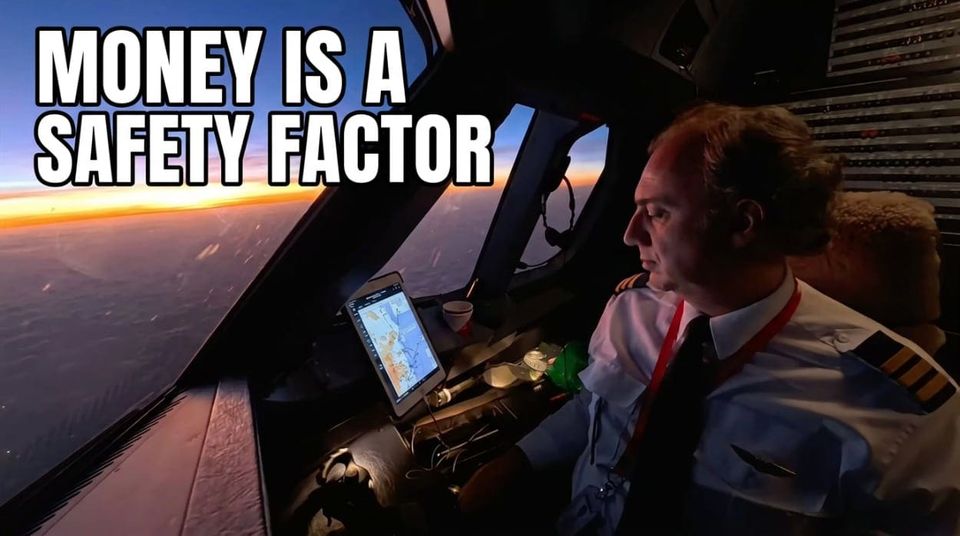
💭 Last December, a very senior captain and colleague, Mario, told me he was leaving. After twenty-two years at one of the most prestigious airlines in the world, he was moving to the United States to start again — as a First Officer. He is fifty-nine.
He was not just any pilot, but one of the most senior captains and a management pilot on a fleet of nearly 100 Boeing 777s. Mario was also a standardisation instructor — the man who instructs the instructors and makes sure other pilots meet the standard. He was one of the company's test and technical pilots — the one you send to Boeing's factory to accept the delivery of the new aircraft. If you wanted to know how the aeroplane should be flown within the specific operation of our airline, he was the reference.
So Mario went to a legacy US carrier — a great airline — to sit in the right-hand seat as a co-pilot.
I did the math quickly, because I wanted to understand his decision. Those airlines run on a strict seniority system. Every new joiner starts as a First Officer, whatever they flew before. The wait to upgrade back to captain is several years. With mandatory retirement at sixty-five, Mario will almost certainly never be a captain again. He told me he'd likely be assigned to the Airbus A320, the aircraft I flew for almost 8,000 hours — a very different aeroplane — flying as the co-pilot beside captains who will, in most cases, be far less experienced than him.
Now picture this. The most senior man in one of the world's leading airlines, changing company, changing continent, changing aeroplane, and sitting as the most junior pilot by seniority next to someone born after he had already been flying jets.
Most people hear that and wince. It sounds like a demotion. It sounds like swallowed pride.
It is neither. And the reason why is one of the most useful ideas aviation has ever produced.
Rank is not role
In a cockpit, two things that look identical are kept deliberately apart: rank and role.
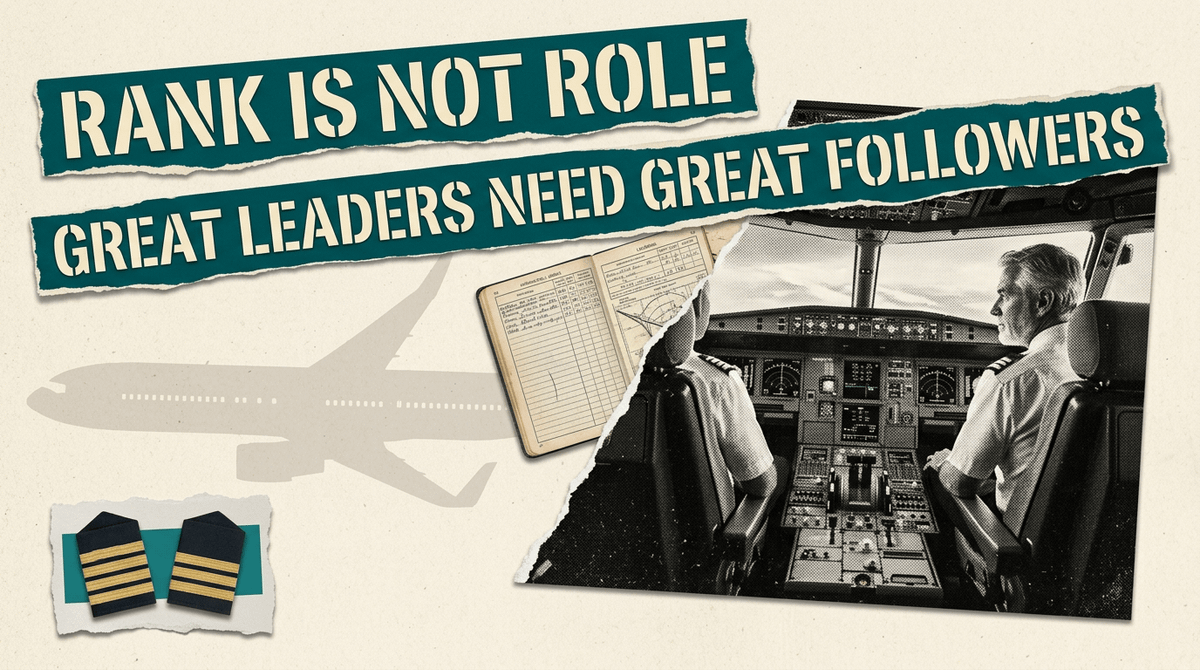
Rank is fixed. There is a Captain and there is a First Officer. The Captain holds the final authority and carries the legal responsibility for the flight. That does not move.
Role changes every single leg. On each flight, one pilot is the Pilot Flying and the other is the Pilot Monitoring. The Pilot Flying handles the aeroplane. The Pilot Monitoring does everything else — cross-checks every change, works the radio, challenges any deviation, and supports the whole operation. And here is the part most people get wrong: the monitoring seat is the harder seat, not the flying one. Accidents are rarely a failure to fly, but mostly a failure to monitor. — 🔗 read more
The two pilots swap these roles turn and turn about. The Captain flies one leg and monitors the next. So does the First Officer. Rank says who is ultimately in charge. Role says who is doing what today. They are not the same, and confusing role and rank is the mistake.
Now put my colleague back in the picture. He will sit in the First Officer's seat. On half his flights he will be the Pilot Flying. On the other half he will be the Pilot Monitoring — the harder job, the one that catches the errors and holds the perspective — and he will be doing it with thirty-five years of flying and a test pilot's eye. That is not a downgrade for the operation. It is a gift to it.
Even the captain chooses to follow
There is a detail here worth slowing down on, because it quietly dismantles the idea that following is beneath the senior person. The whole of aviation — and spaceflight — is built on the opposite belief.
When a flight gets difficult — a system failure, weather closing in, a decision with real consequences — the Captain will often hand the controls to the First Officer and deliberately take the monitoring seat himself. He does not do this because he is tired or because the other pilot flies better. He does it because the monitoring seat is where the judgement lives. Flying the aeroplane consumes attention; monitoring it frees you to think, to weigh options, to hold the whole situation in view.
And yes — when the work is done and the aircraft is about to enter the final phase of the approach, the captain will often take the controls and land it. But we'll come to that in just a minute.
But the most experienced person in the cockpit, at the hardest moment of the flight, chooses to support the whole flight, not only the handling of the plane. That is the seat that has the better point of view. Supporting, done well, is not the absence of leadership. It is often its most senior expression.
The captain keeps the last word — and that's exactly why the follower matters
None of this dissolves the captain's authority, and it shouldn't. When a crucial decision has to be made — a technical failure, a medical emergency, a diversion — someone has to own it. In that cockpit, it is the captain. Operationally, morally, legally, the last word is his. Mario knows this better than anyone; he spent two decades being that last word.
This is also why, once the hard work is done and the aeroplane is settled on final approach, the captain will often take the controls back to land — the moment I promised we'd return to. It isn't about who flies best. It is the physical shape of the last word: the person who carries the responsibility puts his hands on the aircraft for the moment of commitment, and answers for whatever follows.
But a leader's authority is only as good as the information that reaches him. And information does not always flow uphill on its own.
In 1977, two Boeing 747s collided on a foggy runway in Tenerife. It is still the deadliest accident in aviation history. A senior, respected training captain began his takeoff roll without clearance. His First Officer had a bad feeling and said something — but too softly, and he dropped the ball when the captain pressed on. Five hundred and eighty-three people died. Aviation learned, at a terrible price, about the authority gradient: the psychological distance between the top and the bottom of a team. Too steep, and the people who can see the problem go quiet at exactly the moment you need them loudest. — 🔗 read more
This is where a senior First Officer becomes a safety system in uniform. A twenty-five-year-old co-pilot might hesitate to question a captain twice his age and rank. My fifty-nine-year-old colleague will not. He is not going to be intimidated into silence. If something starts to drift, the words will come — clearly, and in time. He flattens the gradient simply by being who he is. The young captain gets the safest possible second pair of eyes: a follower who will always tell him the truth while the truth can still change the outcome.
At the end of the day, the captain is ultimately the person in charge of the ship and all the souls on board. And that deserves the best followership he can get.
The quality of a leader is capped by the quality of the follower
Here is the idea underneath all of it, and it is the one I keep returning to.
We are sold leadership everywhere. Ten thousand books, ten thousand courses. Almost nobody defends the follower. We are often taught that to follow is to obey, to go along, to keep your opinion to yourself. So the good ones stay quiet, and the operation drifts toward the rocks while everyone watches it happen.
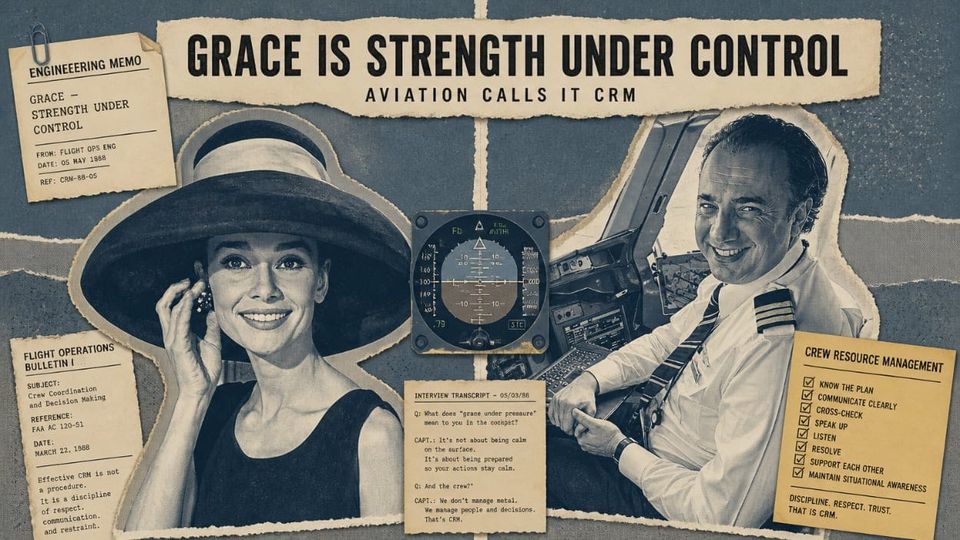
Aviation learned the opposite lesson. It made the follower a guardian, because a passive co-pilot is fatal. A good First Officer is not a yes-man. He is the backup of the whole flight, voices the doubt, closes the loop, and holds the line when the captain needs it most. That is not insubordination. It is the system working as designed. — 🔗 read more
And it means something uncomfortable for the way we usually talk about leadership: a leader's ceiling is set by the follower beside him. Good followers survive a bad leader. Bad followers grind a good leader to zero. The finest young captain in the world, surrounded by silent, compliant crew, could be one bad assumption away from disaster. An average captain with Mario in the right-hand seat is far safer than he knows — because when the moment comes, the quality of the information he receives will decide the outcome, and that information will be world-class.
The follower does not diminish the leader. The follower is what makes the leader's job possible.
Off the flight deck
You do not need a cockpit to use this.
Think about the person on your team who is senior to their title. She is the veteran who joined late, the expert who reports to a younger manager, the specialist who has forgotten more than the department knows. We treat those situations as awkward. Whose ego gets bruised? Who is really in charge? The cockpit answers cleanly: separate the two questions. Rank decides who owns the decision. Experience will always feed that decision, regardless of the stripes on the epaulettes.
The leaders who understand this do something rare — they hire people more experienced than the role and they are glad of it. Carlos Ghosn once said the most dangerous person in your company is the one who agrees with everything you say. A manager who is threatened by a senior subordinate is optimising for comfort. A manager who wants that person in the room — challenging, monitoring, telling the truth in time — is optimising for outcomes. One feeds on ego, the other one on safety.
And if you are the senior one taking the "junior" seat — the new job, the reset, the move that looks sideways or backwards on paper — the cockpit offers a quieter reassurance.
Your value was never your rank. It is what you carry in your head, and that comes with you into any seat. My colleague will retire as a First Officer. He will also be, on most days he flies, the most experienced person on the aeroplane. Both are true, and only one of them matters when it's dark and something breaks.
The seat doesn't measure the person
☝🏼 We assume the highest rank in the room is the most capable person in it, and the one in the junior seat has the least to offer. The cockpit is built on knowing that isn't true. Rank decides who signs. Role decides who works. But when the crucial decision comes, it is often the follower — the one who was never "in charge" — who you can rely on. The First Officer is not necessarily the least experienced person in the room. Sometimes he is the reason everyone gets home.
Farewell, Mario, and blue skies. I'll listen carefully for your voice next time I find myself in Chicago airspace.