I have ADHD. I also fly airliners. Here's how that works.
I have ADHD, and I fly airliners. The focus isn't willpower — it's the cockpit: an environment that removes distraction plus a system of SOPs. Build your own cockpit.

Why a Pilot With ADHD Can Focus for Eight Hours
Welcome to the first issue of Pre-Flight — the cockpit, translated for everyday life.
The first time I found myself in a peaceful state of mind was at 13 years old when I started flying paragliders. It continued with hot air balloons and later with aviation.
Here's something I don't say often: I have ADHD, the inattentive kind without hyperactivity syndrome. My mind wanders off like my dog when a bird flies over. And yet I can sit in a cockpit and hold my attention, phase after phase, across a long flight. That contradiction is perfectly natural, and it has to do with my work environment.
The skill of focussing has nothing to do with willpower
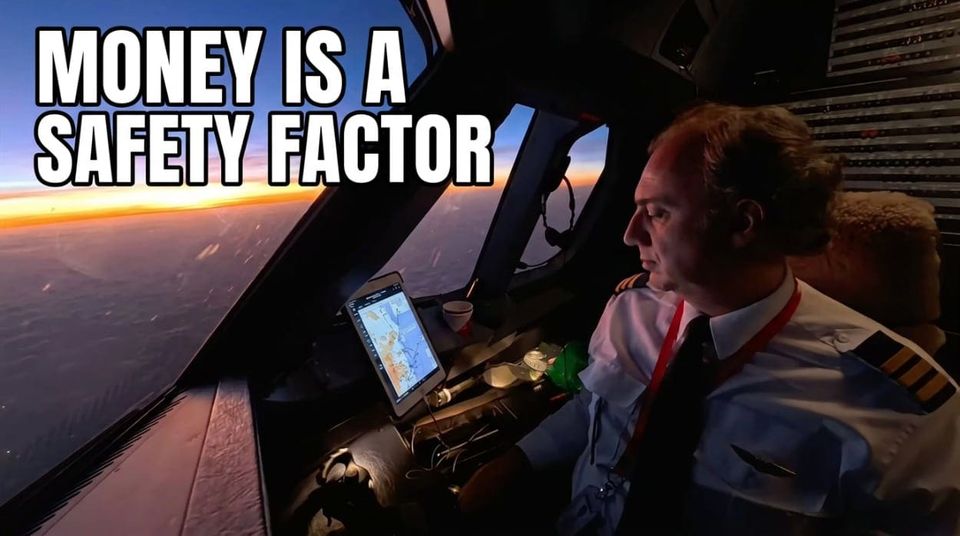
The cockpit is an environment engineered to remove distraction. Below 10,000 feet and in critical phases of flight, we run a "sterile cockpit": no conversation that isn't about flying.
- no phone
- no small talk — thus no distraction
No noise, no stimulation to pull our minds away from the moment. And on top of that environment sits a system of standard operating procedures — SOPs. Checklists. Flows. Callouts. I'm not deciding what to attend to next. It is already choreographed and rehearsed. There are more similarities between a flight crew and an orchestra than one can imagine.
Hand the mind a structure, and even a volatile brain locks on
The psychologist Mihály Csíkszentmihályi spent his career studying this state. He called it "flow", or "the zone". He found it needs three things:
- a clear goal — e.g. fly the plane
- immediate feedback — e.g. the ground and the sky where they should be
- a challenge matched to your skill — e.g. land the plane on the centre line, within the limits
Look at a cockpit and you'll find all three, by design. The goal is always defined. The instruments feed back in real time. The task stretches you without drowning you. The cockpit isn't just distraction-free; it's where I find myself in flow.
Which means the focus I have up there was never a trait I was born with. It's a product of environment and system. And that's the part worth stealing, ADHD or not.
Most of us try to focus the hard way: sit down, grit your teeth, use your will to pay attention. For me, it's a pure waste of energy. The answer is the opposite. Don't fight your attention. Build the conditions that make focus the default state.
The ideal for a brain like mine is to build your own cockpit. Strip the environment: phone in another room, notifications off.
When your "mind full" becomes "mindful"
Repeat the checklist like a mantra, and keep bringing your attention back to the task. You're not trying harder. You're removing the reasons your mind leaves.
I used to think my ADHD was a wall between me and deep work. The cockpit taught me it isn't a wall; it's a signal that I need better design. Willpower was never the tool.
If your focus keeps slipping, don't ask what's wrong with you. Ask what's wrong with the room.